

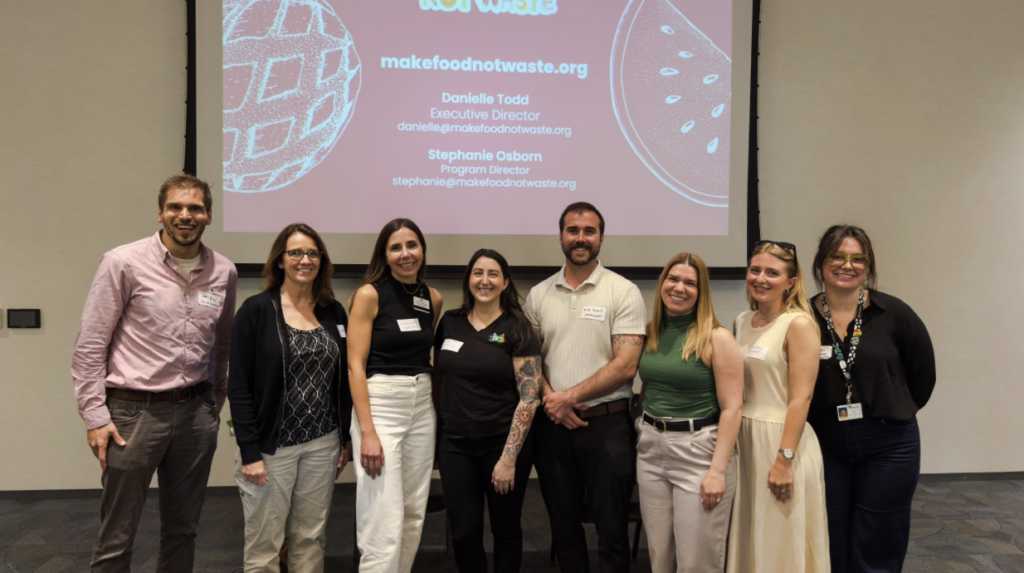
Pictured:
John Kraus, Eastpointe; Whitney Calio, Oakland County; Amanda Woods, Oakland County; Ashely Tebedo, Troy; Nick DuPuis, Birmingham; Devan Dodge, Royal Oak; Alexis Weinberg, Sterling Heights; Kelly Humes, Oakland County.
(this wasn’t everyone)
Local Governments Lead on Food Waste Reduction
Nationally, food waste contributes an estimated 8–10% of global greenhouse gas emissions according to the United Nations. And with 50% of Michigan’s population living in Southeast Michigan, it means we have an outsized responsibility and opportunity to address it. Because Southeast Michigan contains both dense population centers and diverse suburban communities, the region has become a testing ground for food waste reduction strategies that are helping shape what food waste reduction could look like across Michigan.
Local governments are increasingly treating food waste reduction as core infrastructure and cost-saving work rather than a niche sustainability effort. Food is one of the heaviest materials in the residential waste stream. When wasted food is sent to landfills, communities pay to transport and bury material that could have been prevented, rescued, or composted instead. And because landfilled food produces methane, a potent greenhouse gas, diverting food scraps from landfills means a healthier environment.
Wasting food also costs residents money. The average family of four throws away $3000 a year in food they buy but don’t eat. Helping residents make the connection between food waste and household budgets can go a long way in making residents more financially secure.
Taking Action
The most visible area of growth in Southeast Michigan has been community organics recycling access. As of June 2026, 16 municipalities have started or are preparing to launch food scrap drop-off programs:
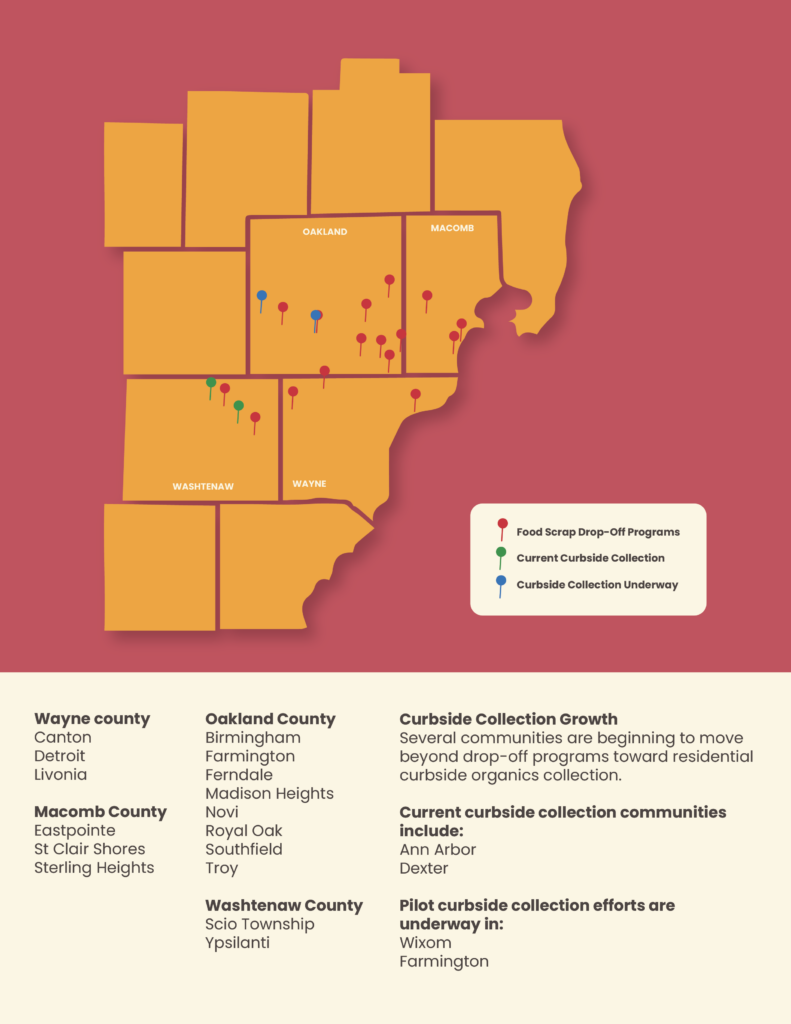
Together, these communities represent approximately 1.6 million residents, or 16% of Michigan’s population.
These are not just isolated pilot projects. Food waste reduction is increasingly becoming embedded into long-term municipal planning and regional infrastructure conversations. Communities across political boundaries are beginning to collaborate around shared solutions. In May, representatives from Ann Arbor, Birmingham, Canton Township, Clinton Township, Dearborn, Detroit, Eastpointe, EGLE, Livonia, Oakland County, Pontiac, Royal Oak, RRRASOC, SEMCOG, SOCRRA, Southfield, Troy, Warren, Washtenaw County, Wayne County and Westland convened to share strategies and coordinate regional action around food waste reduction. Topics included leading by example in government-owned buildings and public events, engaging residents around household cost savings, and expanding drop-off and curbside collection programs. The convening is open to all SE Michigan governments to join and is expected to continue regularly.
Despite growing momentum, barriers remain, including limited regional food scrap processing infrastructure, inconsistent resident education, and the need for broader commercial participation. As these and additional local communities continue to provide leadership, it will be critical to expand processing infrastructure, strengthen public education, and increase participation from businesses, institutions, and schools.
Southeast Michigan is still in the early stages of building a comprehensive food waste reduction system, but the pace of municipal engagement has accelerated dramatically over the past several years. What was once a niche sustainability issue is increasingly being recognized as a core economic, environmental, and infrastructure opportunity. The next phase will require deeper collaboration between local governments, residents, businesses, schools, and state leaders–and you! If your community is not already taking steps to address food waste, reach out to your local officials and let them know how important this work is.